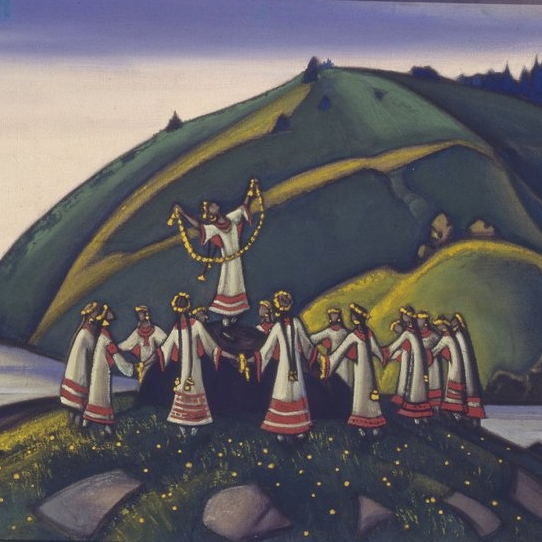
Sharing some thoughts evoked by two coinciding things. First, I’ve been listening to more jazz than usual, prompted by some of the Substack accounts I follow. Second, I attended a performance by the Boston Ballet yesterday afternoon which paired Stravinsky’s Rite of Spring with a dance choreographed to selections from Max Richter’s recomposed Vivaldi Four Seasons.
These stirred up thoughts about what makes classical Western music different from most other forms or genres of music. The most important difference, in my opinion, is formal structure. Classical music uses the same elements as most any other music – melody, harmony, timbre, rhythm – but combines them within large formal structures in a way that is unique.
Let me begin with the second event – the ballet performance. Stravinsky wrote a score that stands out, despite its numerous contrasting sections, as a unified whole. He uses thematic and harmonic relationships to create a musical story that runs continuously from start to finish. This comes out of a long classical music tradition that started back in the early Renaissance as composers sought to find ways to unify long pieces (such as the movements of a mass) leading to long forms such as are found in the symphonies of Bruckner, Mahler, Shostakovich and many others. The Max Richter music, on the other hand, other than using melodic phrases from Vivaldi’s great work, fails to do that. It is a series of short stand-alone “tracks” like in a pop album. Each one stands alone. They could be presented in any order without making much of a difference. The choreography in the performance I attended yesterday was spectacular – but the music without the dance, unlike the Stravinsky score, wouldn’t have been nearly as interesting. Richter creates soundscapes that are great for accompanying something else (or for drifting off to sleep if you suffer from insomnia) but he does not write music that tells a symphonic musical story that is derived from a long, deep, internal structure capable of sustaining interest for an extended period.
Now, to jazz. Over the past several weeks I’ve listened to quite a bit of fabulous jazz compositions, performed by the genre’s greatest talents. Yet, despite appreciating the amazing musical talents of the performer/composers I heard, the reason why I personally prefer classical music and rarely listen to jazz became evident. It comes back to the uniqueness of the way classical music employs the basic tools of music to create large forms that make the whole, no matter what contrasting sections occur along the way, into a logical, inexorable story.
For instance, some jazz, like free jazz, creates fascinating soundscapes, not so different from Richter’s music, that you can lose yourself in, but that isn’t intended to “go” anywhere. It drifts. Other styles use extraordinarily interesting harmonic progressions over which to improvise – yet in relatively short phrases that repeat. As a result, during my recent listening stint, it was rare to find long tracks of anything, as the organizational structure doesn’t support long forms. The duration can be extended by each player taking a long solo over a repeated harmonic progression, but that is very different from what a classical composer does when writing a long work. Only in classical music is tonality, harmony, melody, rhythm and the other core elements of music developed in a way that creates distinguishable musical statements, transitional sections, development sections, closing sections, etc. that, all together, result in a logical, ordered whole.
Of course, each to their own! I enjoy a vast array of music, some more than others, but my intent here was to share thoughts that underly my personal preference for classical music which, I believe, is unique in this one respect. No other music, from anywhere in the world, uses musical architecture in an equivalent way.