Sorry, no results.
Please try another keyword

This composition appears on the album:
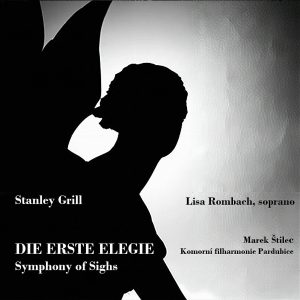
Die Erste Elegie
GLOBAL MUSIC AWARDS – GOLD MEDAL WINNER
CLOUZINE MAGAZINE – BEST CLASSICAL ALBUM
LIT MUSIC AWARDS – SILVER MEDAL WINNER
I am, by nature, not a religious person, and as such, the fact that I have long been so drawn to Rilke’s poetry remains for me an enduring mystery. Yet, it remains a fact. Over the years, I have read through hundreds, if not thousands of poems, always with an eye to whether the poem is a good candidate for music – and quite frequently I have passed by an otherwise good poem only because of a passing mention of the word “god” in it – a term which I have always believed to be more subject to misunderstanding and abuse than any single other word in English (or in any other language).
Yet, despite the omnipresence of God and Angels in his elegies, for some reason that I have never quite been able to elucidate to myself, I remain drawn to these poems in a powerful way, different from the work of any other poet. As I read the words, it seems to me that when Rilke says “God” or “angel” he is perhaps referencing something disembodied that is entirely different than the intention of any other writer using the same words. Of course, I have no real idea whether or not Rilke himself was religious in the ordinary sense. I am no expert on Rilke. I just read his words and take away from them whatever it is they indicate to me.
I am, without any shreds of doubt, an atheist, and believe neither in god or angels. Yet, when I read those words in Rilke’s poems, I understand them to mean (for me) something that is very palpable and real – in feeling – about the nature of ourselves and our place in the world. I know that the world around us that we can see and hear and touch is only a fragment of reality, serving only to mask an immense invisible world that is closed to our senses. The world we call “real” is the least real aspect of the world of which we are a part. The “real” world is one we cannot fathom, except indirectly, in a limited way, through mathematics and science.
It is Rilke, more so than any other poet with whom I am familiar, who writes about the invisible world around us. Other poets describe the beauties (or the terrors) of the world we can see, but Rilke uses words that may be rooted in that world only to leave it and open a door beyond that to what we cannot fathom. Although I do not believe that angels, in the ordinary meaning of that word, exist, I had an immediate visceral, gut acceptance of Rilke’s words when I read “Every Angel is terrifying.” It reminded me of my love of studying stars when I was a child, and the terror that I felt when I began to understand, in a small way, the immeasurably vast distances between stars and how minute in comparison to the scale of the universe we all are (despite our species’ limitless capacity for self-aggrandizement). That terrifying realization put a quick end to that line of study for me. And he does, at least to my understanding, clearly describe how in the face of that vastness, humans shut themselves down, to shield themselves from the enormity of what surrounds us in order to protect ourselves. His opening line of the first elegy so powerfully expresses this – “Who, if I cried out would hear me among the Angels’ Orders? and even if one of them pressed me suddenly to his heart: I’d be consumed in his more potent being.”
But, more than an expression of humanity’s relationship to the infinite, invisible world, the poems are elegies – laments for the dead. But it is not just the dead that concern Rilke, but the relationship that the living have to those who have left the world of the living. The perhaps inevitable result of the too early death of my own father, this subject has never been far from my mind. How it is that we can bear such grief of loss is at the heart of these poems. While most people seem to me to find ways to ignore their mortality, or push it down to some deep place where they can avoid thinking about it, that has never been the case for me. And, as I grow older, it becomes still harder to ignore. The division between the living and dead is always present for me, and that, perhaps, is the thing that attracts me to Rilke’s ten elegies and his Sonnets to Orpheus. What better symbol than the Orpheus myth to explore the subject of the relationship between the living and the dead?
Despite my love of these poems, they never seemed right to me for music – too long, too abstruse, too rambling. But, during the month of September, as we approached the anniversary of my mother-in-law’s death and the birth of our first grandchild, a time that brought back painful memories of the death of my own mother just a week after the birth of my son nearly forty years ago, I found myself reading and re-reading the first elegy – and a definite idea for how to express it musically grew in my mind. In the midst of this raging pandemic, my wife and I packed for a long visit to our son’s home, to help out in the weeks before and after the birth of our lovely granddaughter. And, there I found myself spending hours writing, laying out the sections of the poem, finding the movement in the words as Rilke carries through on his train of thought, seeking in music to describe the ineffable that cannot be put into words. Returning home after the new parents were settled into life with their new baby, I kept writing, completing in November what turned into music I began to think of as a concerto for voice and orchestra.
This composition is from the “Orchestral Music” category. All works in this category:
YEAR
Title
Instruments
Duration