Blog/News

Minimalism?

Sharing my response to someone arguing for a reevaluation of the merits of Phillip Glass’ minimalist music.

No thanks! I will pass! Just my opinion but minimalist composers leave out the essential elements of music that allow it to dive into the very deepest part of your psyche and make you FEEL emotions you didn’t know you had, sending shivers up and down your spine. If you want to drift along, feeling nothing, detached from your emotions, then Glass (and his endless followers trying to cash in on his success) is for you! I get why minimalism is so popular today. People are bombarded so constantly, they intensely need to be numbed. They don’t want to feel more. They want to feel less. Minimalist music (and its appallingly mind numbing but popular successor, ambient music) does the trick.

From time out of memory it has been the job of artists, of all kinds, to wrench people out of their complacency and make them intensely feel the full range of human emotions. From the ancient Greek playwrights to Shakespeare, et al.

Gertrude Stein wasn’t Shakespeare. Glass isn’t Bach.

Abby Whiteside and Heinrich Schenker

Shortly after starting my studies at the Manhattan School of Music, majoring in piano, hours of practicing with ingrained bad habits led to a long-lasting, painful case of tendonitis in both hands. Unable to practice, I took off for a semester, and then, still not recovered and unable to practice, I went back but switched my major to music theory. And never looked back. An unplanned but life-changing decision for the better.

However, in a desperate search to discover what I was doing wrong at the piano, I continued taking piano lessons – but with different teachers. I began studies with the wonderful composer and pianist Robert Helps at MSM and, outside of school, studies with Joseph Prostakoff. Both were disciples (I suppose that is the best word for it) of Abby Whiteside, an extraordinary pedagogue who had carefully analyzed the mechanics of the body in relationship to the piano keyboard. Little by little, my tendonitis ebbed away and I was able to spend more and more time at the keyboard without pain.

Those studies converged with what I was learning in my music theory classes – leading to me gaining an entirely different understanding about music. In music theory classes, the technique for playing I was learning in my piano lessons led to an interest in the theoretical concepts of Heinrich Schenker. I dove into his “Five Graphic Music Analyses” and also “Structural Hearing” by Felix Salzer. Both made an enormous impression on me, enabling me to realize the overarching structure to be found in the great classical works – and that while the details matter, playing that did not steer in the direction of long-range musical destinations missed the heart of the music.

At my piano lessons, I was learning how to depress keys, not with the small finger muscles, but with the larger levers of upper arms and torso, a technique which eliminated my lingering tendonitis. These larger gestures incorporated groups of notes rather than the incessant up and down of one note after another – leading to a sense of phrasing with destination. Even the basic method of learning was a do over. Instead of starting slowly and gradually increasing tempos, I learned that this only drummed bad habits into my playing, as the physical movements needed to cover the keyboard at speed were different than those used when playing slowly. I learned new music, no matter how fast, by always playing at tempo, what Abby Whiteside called “outlining.” As an example, in 4/4 time, I would play only the first beat of every bar. Then gradually introduce, the third beat, then the notes that fell between, until all the notes were there, always at tempo, and guided by the larger gestures that depressed keys over longer spans of time.

This method of playing made Schenker’s theoretical concepts palpably real and sensible. The first note of a melody was headed towards a goal that might be many measures away, and all of the notes in between were a means to get there. It was that long range motion that gave the music a sense of direction and musical purpose. Without it, playing devolved into a series of disconnected gestures, losing the momentum of the music. This realization not only changed the way I listened to musical performances but also, as I was beginning to compose music of my own, provided a groundwork for how I thought about how to get from note to note in a composition – and create not just a series of pleasing sounds but a compelling (hopefully) musical story.

Architecture in music

In music, form (or architecture) is as important an element as melody, harmony, rhythm, etc. Perhaps the most important!

Music today doesn’t need to employ classical forms (e.g., sonata, rondo, minuet/trio) but whatever the architectural design, it should accomplish the same purpose – namely moving along a compelling musical story.

The forms so common in classical music became so because they achieved that with their balance of statement, transitions, development, recapitulation, closure.

Personally, I find that kind of architecture sorely lacking in much contemporary music. Just my opinion, but many composers writing today seem to lack basic skills in counterpoint and formal structures. A lovely sound fabric or exciting rhythm or interesting melody is not enough.

69th GRAMMY AWARDS – FOR YOUR CONSIDERATION

It has been my busiest year yet. With hundreds of compositions as yet unrecorded, I have been trying to catch up on the backlog, mostly in vain! I know there’s a lot of music here but I hope you’ll take time and gradually listen your way through.

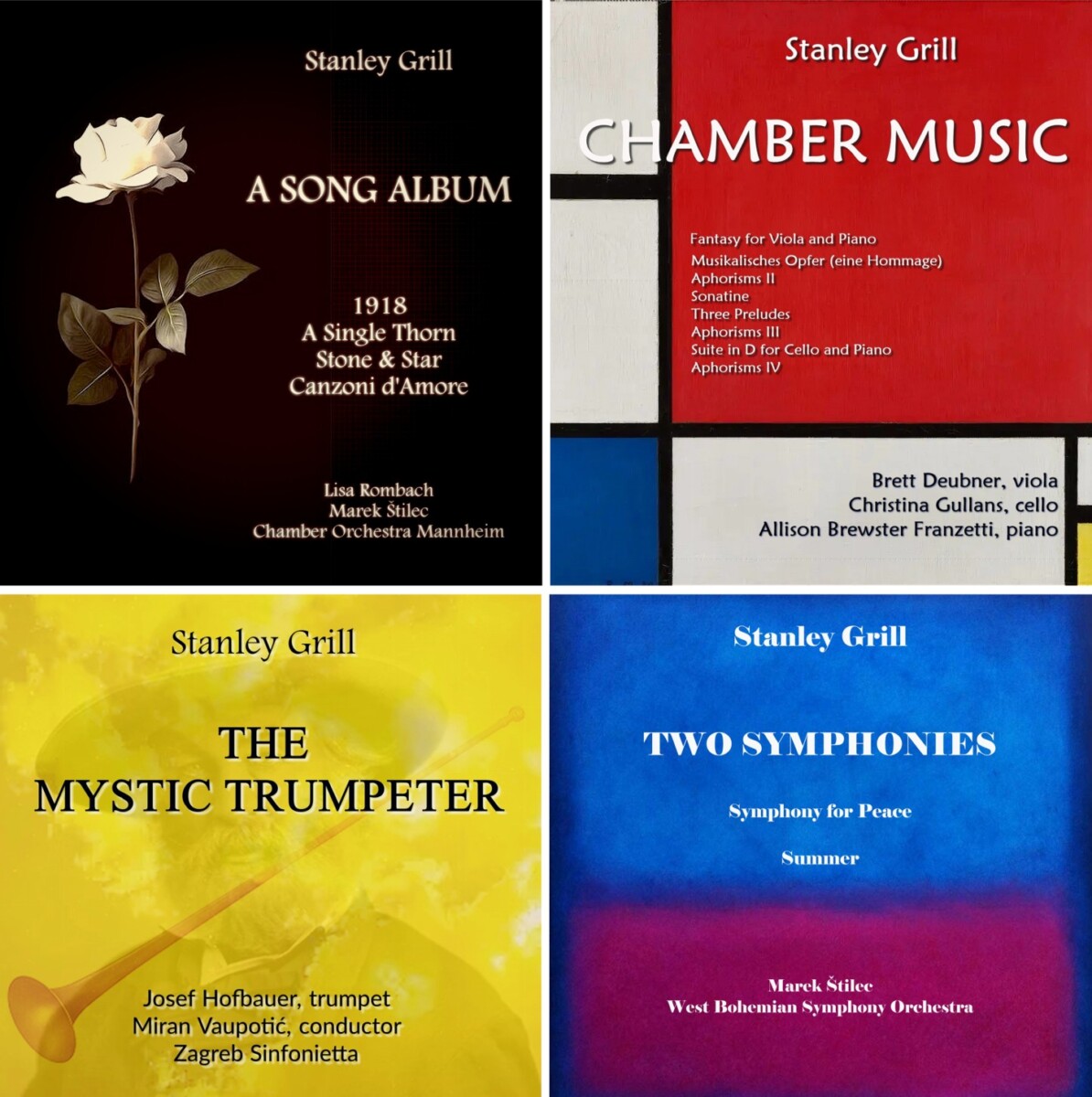
A SONG ALBUM submitted in the Classical Solo Vocal Album category. Featuring soprano Lisa Rombach and the Chamber Orchestra Mannheim conducted by Marek Štilec. The album includes four song cycles: 1918, A SINGLE THORN, STONE & STAR and CANZONI D’AMORE.

A SONG ALBUM

CHAMBER MUSIC submitted in the Classical Chamber Music/Small Ensemble Performance category. A double CD length album of music for viola and piano, piano solo and cello and piano. Featuring Brett Deubner, Christina Gullans and Allison Brewster Franzetti.

CHAMBER MUSIC

THE MYSTIC TRUMPETER submitted in the Classical Instrumental Solo category. Featuring trumpeter Josef Hofbauer with the Zagreb Sinfonietta conducted by Miran Vaupotić. Music inspired by the poem of the same title by Walt Whitman.

THE MYSTIC TRUMPETER

TWO SYMPHONIES submitted in the Classical Orchestral Performance category. Featuring music from my MUSIC FOR THE EARTH and MUSIC FOR PEACE projects. Performed by the West Bohemian Symphony Orchestra conducted by Marek Štilec.

TWO SYMPHONIES

A ramble…

“How do you know but ev’ry Bird that cuts the airy way, is an immense world of delight, clos’d by your senses five?”

William Blake.

This is going to be rather a ramble, hopefully one that is more coherent than not, but nevertheless a ramble. My reaction to the world we’re living in today, with the firehose of news, mostly bad, and the endless torrent of opinions pouring out on social media. So many people, myself included, with various degrees of success, shouting out into the virtual universe, here I am, please pay attention to me.

I began this ramble with a favorite line by William Blake that often pops into mind. I think of it often when reading whatever news story or opinion piece that comes to my attention, as a reminder that very little of what people write is reflective of reality. Of all the things that we think we know, virtually none of it is really knowable. So little of it is something we experience directly so that we can say, I saw that myself, or I tested that out and, sure, it really works, the evidence is there. Most everything we think is going on in the world is reported second hand (or third, or fourth, etc.) and you can’t assume it to be true. At best, you have to weigh the reliability of sources, and conclude that some things are, perhaps, more likely to be true than others.

The first gate is, of course, our own senses and their limitations. As suggested by the Blake quote, what we sense bears little relationship to reality. Everything we perceive is transmuted along the way. We don’t see, hear, smell, taste or feel anything directly at all, so we can’t know what they really are. Only the trail they leave as they get from outside to inside, assuming we are paying attention enough to notice them. On top of that, there’s all of our own preconceptions, which shape what we perceive into some picture or conclusion, that may or may not reflect some sort of reality. We are biased observers, at best, and anyone who doesn’t question themselves is an unreliable reporter.

The second gate is what we can observe first-hand (very little) versus what we have to take on faith from others (most everything). This applies to everything we think we know. I can know, for instance, with a fair degree of confidence that despite protestations to the contrary, my wife was snoring in bed last night because I woke up and heard it. What I don’t and can’t know for certain is nearly anything I read in the news. In our world today, like many others, I avidly read and try to stay on top of new about the wars in Ukraine and Iran. However, as I do so, I try to keep in mind, that when it comes to reports about war, the news is even more unreliable than about most other subjects (and having on occasion been involved in situations on various jobs that were reported on in the news, I know from first-hand experience, that little of what is reported is accurate). Misinformation has always been a tactic of warring parties, so I have little reason to believe anything said by “talking heads” on the news about what is really going on in Iran, Ukraine, Russia, or anywhere else where the players are motivated to lie. Knowing this, I try my best to parse through the news I happen to read, figure out whether or not sources have any reliability, and frame out some story or other – one that I know may or may not be real.

It is no different with all other things that, taken all together, make up my picture of the world. For instance, I have always had a strong interest in the sciences and am a sucker for all things scientific in nature, to the extent I can even understand them. Do I believe in quarks? Well, I don’t really understand what they are but it seems likely to me that they are something real given the general consensus of physicists in the field who have dedicated their lives to their field of endeavor and written studies that go through the gauntlet of fellow scientists (aka, scientific method) and come out the other end. But, even then, that doesn’t mean they are really right. After all, many scientific theories hung around, believed in by most for centuries, until someone wiser pointed out their fallacies. But analogous to how I digest the news, I always question the sources. Where is the information coming from and is there good reason to believe that source is more reliable than others.

But, then again, consensus is hardly an indicator of reality. Most people, for instance, have reached a consensus that somewhere or other in the universe there exists something they call God (or plural Gods) – a being (or beings) worthy of spending a great deal of time worshipping or thinking about or modifying their behavior to please (or displease). Well, that is one consensus opinion that never, from the earliest age I can remember, made the slightest bit of sense to me. I distinctly recall, sitting in temple with my family as a small child, wondering if all of the adults around me actually believed in the apparent nonsense that was coming from the rabbi standing in the pulpit. In the years since, largely motivated by the obsession so many people have with religion and the impact of that obsession on the lives of so many, I have read millions of words, arguing this way or that, on the subject – and always come to the same conclusion I intuited when I was six – namely, that the beliefs of every single religion, throughout the history of humanity, is all exceedingly unlikely to be a true reflection of reality. That said, coming around again to Blake’s beautiful sentence, I may well be missing out on the delightful interior reality of every little bird that flies by me. That part of it does seem more likely. Reality is far more than our senses can perceive. But turning to a God (or Gods) as an explanation of all that we cannot understand or perceive just seems to me to be weak thinking.

Well, that ramble took a different direction than where I started out – but so it goes. One thing leads to another. Back to the news. As “talking heads” on the news or on social media, who make a living by jolting up the adrenaline levels of their viewers or readers, come to my attention, I try my best to take a step back, take a deep breath, and not let myself get worked into a lather. They are motivated, by either greed or money, or greed for attention, to be provocative, but that doesn’t mean they have a clue. The opposite is more likely. Most lack the clarity of thought or self-reflection to deal with the complexity of reality and question their own opinions or perceptions of whatever subject they are going on about. I often find myself reading something and feeling, yes, this is right on target, only to find, on further consideration, that there’s less to whatever they were saying than was apparent upon first read. Or the opposite. My initial reaction is a negative one, but then, upon further reflection, I realize they might have more of a point than I gave them credit for at first glance. To make matters worse, as AI-generated slop increasingly dominates what algorithms feed to me on social media, what is really true recedes further and further out of grasp, like looking through the world through the wrong end of a telescope.

Although aware (often painfully so) that my personal joys and desires are accidental with no inherent meaning other than that they are mine, I plow on, occasionally expressing myself (as I am doing here) in words, but most often, spending my hours deciding on which next note is the right note to jot down on a staff. It may amount to little but whatever pleasure it gives to me (or to others) is enough. Reminiscent of another famous sentence, this one by Voltaire, that “we must cultivate our own garden.”

By nature, I tend more towards excitability than philosophy. It takes hard work for me to rein myself in and avoid allowing others who attempt to share their intense anxiety about life get to me. For sure, there are endless horrors going on in the world, no different (actually perhaps a bit less than in prior eras) than throughout human history. What to do with all of that information pouring in is the big dilemma. What, out of all that torrent of information and opinions, is actually real? Of that which is real, what can I actually do something about? And, if there is something to be done, what is that something?

As I reflect on all of this, to my own surprise, I have found that my world view has shifted as I’ve grown older. The firm opinions that I held for most of my adult life have changed. For one thing, I was long convinced, evidenced by my consistent votes for Democrats as opposed to Republicans, over 55 years of voting, that generally speaking, Democrats were wearing the white hats and Republicans were the bad guys in my filmic version of the world (oops, this ramble just migrated into politics). In my attempts to not immediately accept what “talking heads” from the left, who mostly held my sympathy, were saying and trying to come to my own independent conclusions, it has become increasingly apparent that, to turn to yet another quote, this one from Shakespeare, “a plague on both your houses” is applicable to today’s (and probably yesteryear’s) politics. Both on the right and the left, both sides are equally unreliable reporters of reality.  In the world of politics, in an Orwellian fashion, black is white and white is black, and neither side holds a monopoly on that sort of thinking. In that world, and what version of this world has ever been different, tending one’s own garden does seem to be very sound advice. Live simply as one can, try to hold fast to what you value most, avoid spreading fear and anxiety, try to pierce through the thicket of misperceptions and outright lies to the extent possible, let others find their own path.

Some thoughts on what makes classical music unique

Sharing some thoughts evoked by two coinciding things. First, I’ve been listening to more jazz than usual, prompted by some of the Substack accounts I follow. Second, I attended a performance by the Boston Ballet yesterday afternoon which paired Stravinsky’s Rite of Spring with a dance choreographed to selections from Max Richter’s recomposed Vivaldi Four Seasons.

These stirred up thoughts about what makes classical Western music different from most other forms or genres of music. The most important difference, in my opinion, is formal structure. Classical music uses the same elements as most any other music – melody, harmony, timbre, rhythm – but combines them within large formal structures in a way that is unique.

Let me begin with the second event – the ballet performance. Stravinsky wrote a score that stands out, despite its numerous contrasting sections, as a unified whole. He uses thematic and harmonic relationships to create a musical story that runs continuously from start to finish. This comes out of a long classical music tradition that started back in the early Renaissance as composers sought to find ways to unify long pieces (such as the movements of a mass) leading to long forms such as are found in the symphonies of Bruckner, Mahler, Shostakovich and many others. The Max Richter music, on the other hand, other than using melodic phrases from Vivaldi’s great work, fails to do that. It is a series of short stand-alone “tracks” like in a pop album. Each one stands alone. They could be presented in any order without making much of a difference. The choreography in the performance I attended yesterday was spectacular – but the music without the dance, unlike the Stravinsky score, wouldn’t have been nearly as interesting. Richter creates soundscapes that are great for accompanying something else (or for drifting off to sleep if you suffer from insomnia) but he does not write music that tells a symphonic musical story that is derived from a long, deep, internal structure capable of sustaining interest for an extended period.

Now, to jazz. Over the past several weeks I’ve listened to quite a bit of fabulous jazz compositions, performed by the genre’s greatest talents. Yet, despite appreciating the amazing musical talents of the performer/composers I heard, the reason why I personally prefer classical music and rarely listen to jazz became evident. It comes back to the uniqueness of the way classical music employs the basic tools of music to create large forms that make the whole, no matter what contrasting sections occur along the way, into a logical, inexorable story.

For instance, some jazz, like free jazz, creates fascinating soundscapes, not so different from Richter’s music, that you can lose yourself in, but that isn’t intended to “go” anywhere. It drifts. Other styles use extraordinarily interesting harmonic progressions over which to improvise – yet in relatively short phrases that repeat. As a result, during my recent listening stint, it was rare to find long tracks of anything, as the organizational structure doesn’t support long forms. The duration can be extended by each player taking a long solo over a repeated harmonic progression, but that is very different from what a classical composer does when writing a long work. Only in classical music is tonality, harmony, melody, rhythm and the other core elements of music developed in a way that creates distinguishable musical statements, transitional sections, development sections, closing sections, etc. that, all together, result in a logical, ordered whole.

Of course, each to their own! I enjoy a vast array of music, some more than others, but my intent here was to share thoughts that underly my personal preference for classical music which, I believe, is unique in this one respect. No other music, from anywhere in the world, uses musical architecture in an equivalent way.

Recent Posts

Subscribe via Email

Enter your email address to subscribe to this blog and receive notifications of new posts by email.

Posts Archive